
Noah Vinoya Earns Outstanding Senior Award

Noah Vinoya earned the Outstanding Senior Award in the Department of Communication here at UC Davis. The Outstanding Senior Award

is given to one graduating/graduated senior who has made outstanding contribution to his or her learning environment through active academic engagement, whether through involvement in a research group or creative production, significant contributions to classroom discussion, leadership in student groups committed to the advancement of learning, or other intellectual pursuits with faculty and fellow students.

Noah earned his undergraduate degrees in Communication and Psychology in 2022. After taking a gap year, he will rejoin the Department and Lab as an incoming MA/PhD in Communication student. His Undergraduate Thesis, titled Does Awe Facilitate Cognitive Control? earned the Highest Honors distinction.

Well done, Noah!!

Congratulations to Mercedes & Noah!

Mercedes Ross (Left) and Noah Vinoya (Right)

Congratulations to Mercedes Ross and Noah Vinoya, who were both admitted to PhD graduate programs this year.

Mercedes will join the Department of Communication at the University of Washington where she will work with Benjamin Mako Hill. Her PhD research will focus on how the internet facilitates cultural evolution.

Noah will stay in the lab as he earns his PhD in the Department of Communication at UC Davis. After a year deferral, Noah’s research will focus on understanding emotional processing of media.

Congratulations Mercedes and Noah!! We are so very proud of you, and look forward to your continued accomplishments!

Why does experiencing ‘flow’ feel so good? A communication scientist explains

Research shows that people who have flow as a regular part of their lives are happier and less likely to focus on themselves. Yulkapopkova/E+ via Getty Images
Richard Huskey, University of California, Davis

New years often come with new resolutions. Get back in shape. Read more. Make more time for friends and family. My list of resolutions might not look quite the same as yours, but each of our resolutions represents a plan for something new, or at least a little bit different. As you craft your 2022 resolutions, I hope that you will add one that is also on my list: feel more flow.

Psychologist Mihály Csíkszentmihályi’s research on flow started in the 1970s. He has called it the “secret to happiness.” Flow is a state of “optimal experience” that each of us can incorporate into our everyday lives. One characterized by immense joy that makes a life worth living.

In the years since, researchers have gained a vast store of knowledge about what it is like to be in flow and how experiencing it is important for our overall mental health and well-being. In short, we are completely absorbed in a highly rewarding activity – and not in our inner monologues – when we feel flow.

I am an assistant professor of communication and cognitive science, and I have been studying flow for the last 10 years. My research lab investigates what is happening in our brains when people experience flow. Our goal is to better understand how the experience happens and to make it easier for people to feel flow and its benefits.

A man paints on canvas in a studio.
Flow can arise when playing games or engaged in artistic pursuits, like writing, photography, sculpting and painting. Somyot Techapuwapat/Moment via Getty Images

What it is like to be in flow?

People often say flow is like “being in the zone.” Psychologists Jeanne Nakamura and Csíkszentmihályi describe it as something more. When people feel flow, they are in a state of intense concentration. Their thoughts are focused on an experience rather than on themselves. They lose a sense of time and feel as if there is a merging of their actions and their awareness. That they have control over the situation. That the experience is not physically or mentally taxing.

Most importantly, flow is what researchers call an autotelic experience. Autotelic derives from two Greek words: autos (self) and telos (end or goal). Autotelic experiences are things that are worth doing in and of themselves. Researchers sometimes call these intrinsically rewarding experiences. Flow experiences are intrinsically rewarding.

What causes flow?

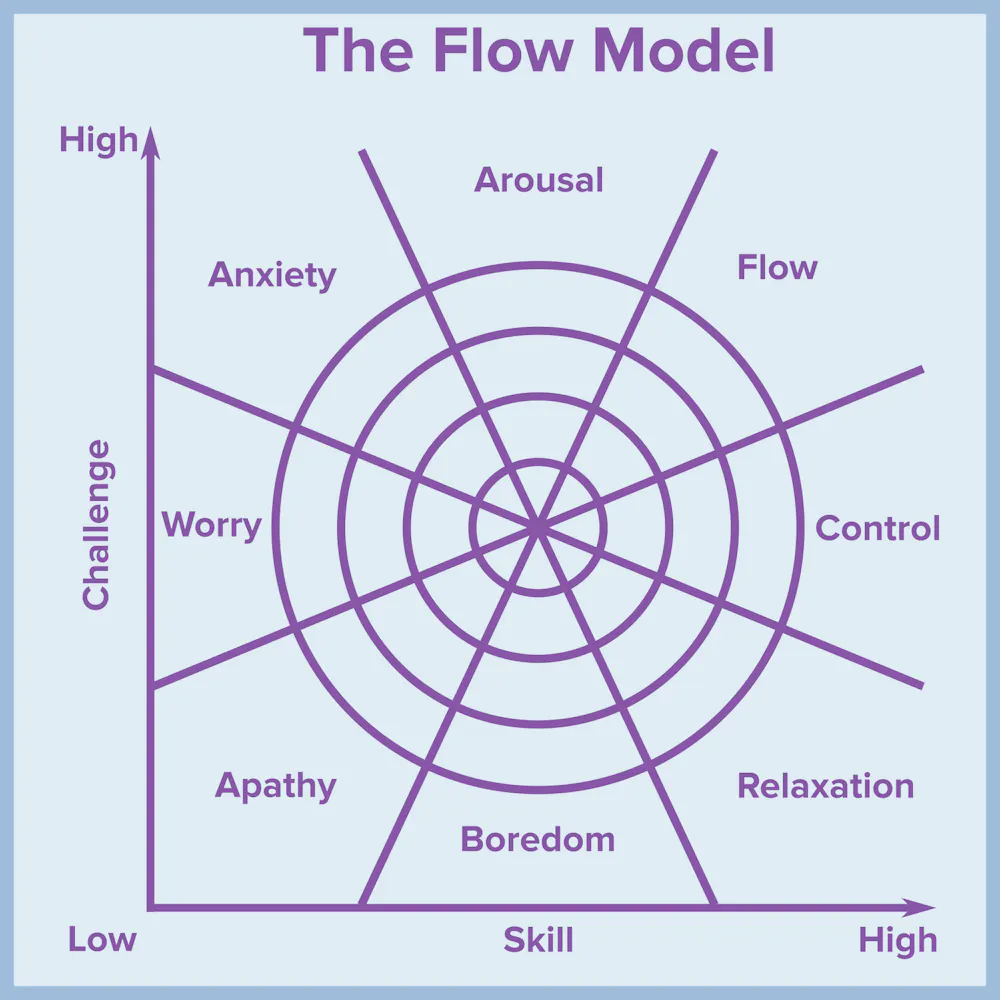
Flow occurs when a task’s challenge is balanced with one’s skill. In fact, both the task challenge and skill level have to be high. I often tell my students that they will not feel flow when they are doing the dishes. Most people are highly skilled dishwashers, and washing dishes is not a very challenging task.

So when do people experience flow? Csíkszentmihályi’s research in the 1970s focused on people doing tasks they enjoyed. He studied swimmers, music composers, chess players, dancers, mountain climbers and other athletes. He went on to study how people can find flow in more everyday experiences. I am an avid snowboarder, and I regularly feel flow on the mountain. Other people feel it by practicing yoga – not me, unfortunately! – by riding their bike, cooking or going for a run. So long as that task’s challenge is high, and so are your skills, you should be able to achieve flow.

Researchers also know that people can experience flow by using interactive media, like playing a video game. In fact, Csíkszentmihályi said that “games are obvious flow activities, and play is the flow experience par excellence.” Video game developers are very familiar with the idea, and they think hard about how to design games so that players feel flow.

Diagram of the relationship between difficulty of a challenge, skill level and the experience of flow.
Flow occurs when a task’s challenge – and one’s skills at the task – are both high. Adapted from Nakamura/Csíkszentmihályi, CC BY-NC-ND

Why is it good to feel flow?

Earlier I said that Csíkszentmihályi called flow “the secret to happiness.” Why is that? For one thing, the experience can help people pursue their long-term goals. This is because research shows that taking a break to do something fun can help enhance one’s self-control, goal pursuit and well-being.

So next time you are feeling like a guilty couch potato for playing a video game, remind yourself that you are actually doing something that can help set you up for long-term success and well-being. Importantly, quality – and not necessarily quantity – matters. Research shows that spending a lot of time playing video games only has a very small influence on your overall well-being. Focus on finding games that help you feel flow, rather than on spending more time playing games.

A recent study also shows that flow helps people stay resilient in the face of adversity. Part of this is because flow can help refocus thoughts away from something stressful to something enjoyable. In fact, studies have shown that experiencing flow can help guard against depression and burnout.

Research also shows that people who experienced stronger feelings of flow had better well-being during the COVID-19 quarantine compared to people who had weaker experiences. This might be because feeling flow helped distract them from worrying.

What is your brain doing during flow?

Researchers have been studying flow for nearly 50 years, but only recently have they begun to decipher what is going on in the brain during flow. One of my colleagues, media neuroscientist René Weber, has proposed that flow is associated with a specific brain-network configuration.

Supporting Weber’s hypothesis, studies show that the experience is associated with activity in brain structures implicated in feeling reward and pursuing our goals. This may be one reason why flow feels so enjoyable and why people are so focused on tasks that make them feel flow. Research also shows that flow is associated with decreased activity in brain structures implicated in self-focus. This may help explain why feeling flow can help distract people from worry.

[Get the best of The Conversation, every weekend. Sign up for our weekly newsletter.]

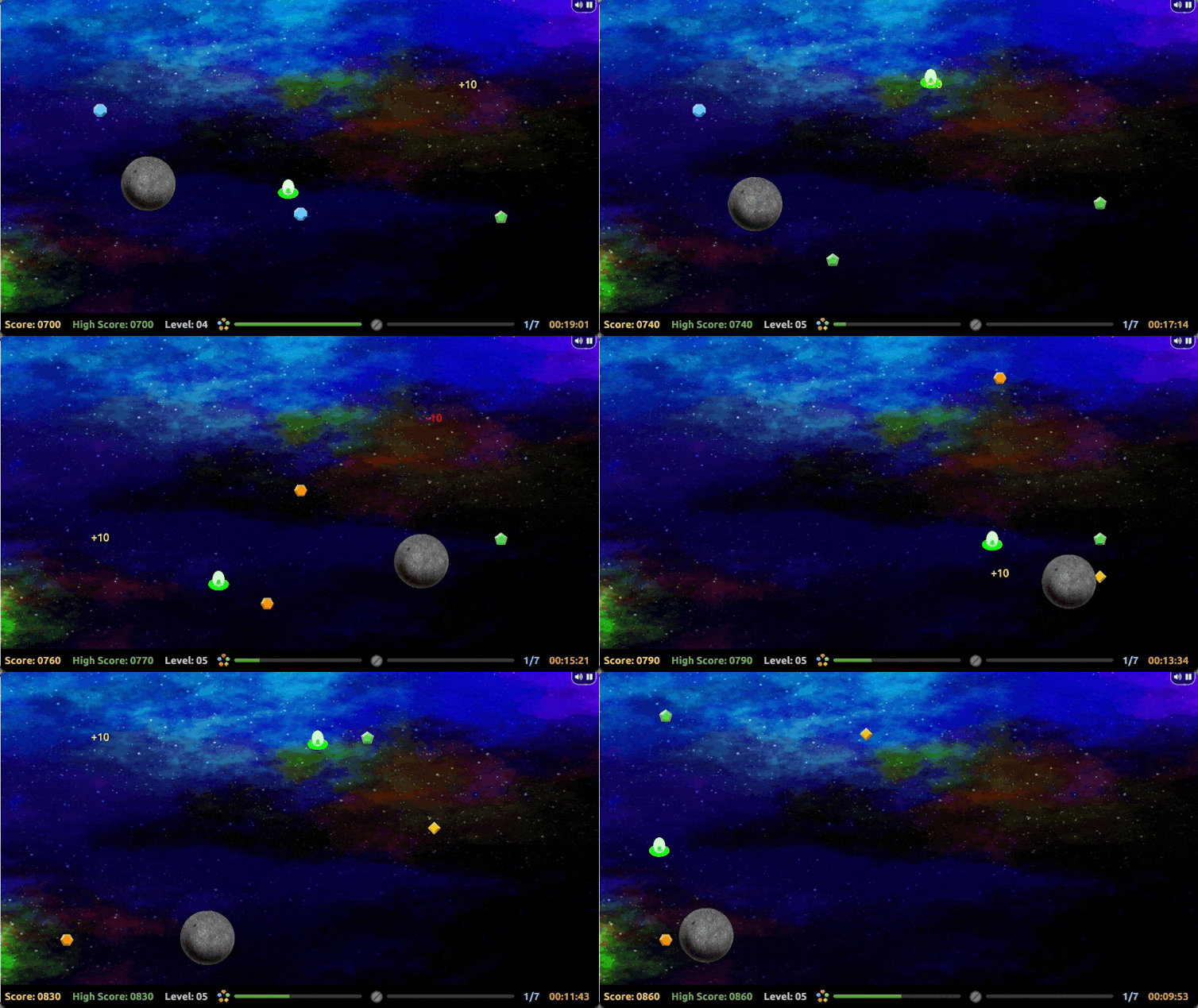
Weber, Jacob Fisher and I have developed a video game called Asteroid Impact to help us better study flow. In my own research, I have participants play Asteroid Impact while having their brain scanned. My work has shown that flow is associated with a specific brain network configuration that has low energy requirements. This may help explain why we do not experience flow as being physically or mentally demanding. I have also shown that, instead of maintaining one stable network configuration, the brain actually changes its network configuration during flow. This is important because rapid brain network reconfiguration helps people adapt to difficult tasks.

Asteroid Impact
A player controls a spaceship to collect crystals and avoid asteroids in a video game called Asteroid Impact. Jacob Fisher via https://github.com/asteroidimpact/asteroid_impact_py3

What more can the brain tell us?

Right now, researchers do not know how brain responses associated with flow contribute to well-being. With very few exceptions, there is almost no research on how brain responses actually cause flow. Every neuroscience study I described earlier was correlational, not causal. Said differently, we can conclude that these brain responses are associated with flow. We cannot conclude that these brain responses cause flow.

Researchers think the connection between flow and well-being has something to do with three things: suppressing brain activation in structures associated with thinking about ourselves, dampening activation in structures associated with negative thoughts, and increasing activation in reward-processing regions.

I’d argue that testing this hypothesis is vital. Medical professionals have started to use video games in clinical applications to help treat attention-deficit/hyperactivity disorder, or ADHD. Maybe one day a clinician will be able to help prescribe a Food and Drug Adminstration-approved video game to help bolster someone’s resilience or help them fight off depression.

That is probably several years into the future, if it is even possible at all. Right now, I hope that you will resolve to find more flow in your everyday life. You may find that this helps you achieve your other resolutions, too.The Conversation

Richard Huskey, Assistant Professor of Communication and Cognitive Science, University of California, Davis

This article is republished from The Conversation under a Creative Commons license. Read the original article.

Xuanjun (Jason) Gong to Present Top Paper at NCA21

Lab member Xuanjun (Jason) Gong will present a Top Paper in the Communication and Social Cognition Division at NCA21. The paper uses drift diffusion modeling to test core hypotheses drawn from Mood Management Theory. Jason’s slides are available online.

Presentation Title: Computationally Modeling Mood Management Theory: A Drift-Diffusion Model of People’s Preference for Valence and Arousal

Authors: Xuanjun (Jason) Gong, Richard Huskey, Allison Eden, Ezgi Ulusoy

Presentation Date: 11/19

Presentation Time: 3:30 PM – 4:45 PM PST

Open Data, Open Materials: https://github.com/cogcommscience-lab/movie_selection

Pre-Registration: https://osf.io/tb3ca/?view_only=9020caac3c9d4bac902168cdebec6fc8

Abstract: Mood Management Theory predicts that people select entertainment content to maintain affective homeostasis. However, this hypothesis lacks a formal quantification of each affective attributes’ separate impact on an individual’s preference for media content, as well as an integrated cognitive mechanism explaining media selection. Here we present a computational model that mathematically formalizes this affective media decision making process. We empirically tested this formalization with the Drift Diffusion Model using two decision making experiments. We found people prefer low valence and high arousal media content additively, and induced low valence mood makes people prefer low valence media content more. We also found that people make less cautious media selection decisions when the two choices have larger valence differences. Our results support the proposed mathematical formalization of affective attributes’ influence on media selection, challenge core predictions drawn from Mood Management Theory, and introduce a new mechanism (response caution) that underpins media selection.